| MediaWiki:Sitenotice |
|---|
| 2026-03-12: Cocopedia.com is now using a new caching system that should make things faster. Please let me know if you encounter any new issues.
2026-03-15: MediaWiki has been reinstalled and the old database and files restored. It was pretty clogged up from being upgraded so many times since 2004. I am also testing out Cloudflare to see if it can prevent the 'bot assaults that took the site down last year. 2026-03-16: Special thanks to Don Barber for hosting a backup mirror of CoCopedia: https://cocopedia.dgb3.net |
Video without RF Box: Difference between revisions
No edit summary |
No edit summary |
||
| Line 11: | Line 11: | ||
File:Video adaptor.JPG|Female RCA to Male F-Type Video adapter | File:Video adaptor.JPG|Female RCA to Male F-Type Video adapter | ||
File:Video without RF box.JPG|Video without RF box | File:Video without RF box.JPG|Video without RF box | ||
</gallery> | </gallery> Radio Shack offered this as Catalog Number 278-255 [https://www.radioshackcatalogs.com/flipbook/1985_radioshack_catalog.html?fb3d-page=126]. | ||
The adapter connects on the TV side and the RCA phono cable is used for the run. | The adapter connects on the TV side and the RCA phono cable is used for the run. | ||
| Line 18: | Line 19: | ||
File:Male_RCA_Female_F-Type.jpg|Male RCA to Female F-Type Video adapter | File:Male_RCA_Female_F-Type.jpg|Male RCA to Female F-Type Video adapter | ||
</gallery> | </gallery> | ||
Radio Shack offered this as Catalog Number 278-252 [https://www.radioshackcatalogs.com/flipbook/1985_radioshack_catalog.html?fb3d-page=126]. During the CoCo's market life, this part was Archer-branded. Later, it was Radio Shack-branded. | |||
The adapter connects on the CoCo side and a television cable is used for the run. Television coax cables (RG-58 or RG-6) are typically well-shielded unless damaged. | The adapter connects on the CoCo side and a television cable is used for the run. Television coax cables (RG-58 or RG-6) are typically well-shielded unless damaged. | ||
[[Category:Hardware]] | [[Category:Hardware]] | ||
Latest revision as of 17:23, 4 October 2023
| WELCOME |
|---|
| Looking for CoCo help? If you are trying to do something with your old Color Computer, read this quick reference. Want to contribute to this wiki? Be sure to read this first. This CoCo wiki project was started on October 29, 2004. --OS-9 Al Read-only mirror: https://cocopedia.dgb3.net |
See Recent Changes. | About this site. | Join the E-Mail List or Facebook Group. | Contact me with updates/questions.
This page was last updated on 10/4/2023. Total Pages: 751. Total Files: 999.
Home / Hardware - Video without RF Box
Color Computers 1 and 2 output their video signal in a way that it could be displayed on a standard definition television on either NTSC channel 3 or channel 4, called RF (radio frequency). PAL versions were also available in the UK and Europe. The CoCo 3 also output RF, along with composite and its RGB connector. The ability to display on a standard television kept the cost down, but also means that the CoCo is limited to the resolution capable on standard definition television sets. In order to create these television signals, the video and audio signals are mixed with a base frequency in a process called modulation, which the TV tuner then demodulates to get back into the original signals to display. Any noise, such as a stray radio signal entering the cables, RF generator circuit, or tuner, may result in poor picture quality.
While NTSC is no longer commonly broadcast in the US (modern broadcasts use the digital ATSC format), most modern TVs in the US still come with a NTSC tuner capable of displaying the CoCos' signals, and remains a viable way to use your CoCo.
CoCos shipped with a switch box that allowed switching between the CoCo and an antenna. The switch boxes often allow in interference, making for a lower quality (fuzzy and noisy) picture. Instead of using a switch box, considering using an adapter without a switch to avoid the interference.
If you're using a standard RCA phono cable (typical as that is what came with the CoCo), obtain a "Phono RCA Female to F-Type Male Connector" such as this:
-
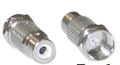 Female RCA to Male F-Type Video adapter
 -
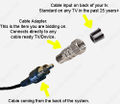 Video without RF box


Radio Shack offered this as Catalog Number 278-255 [1].
The adapter connects on the TV side and the RCA phono cable is used for the run.
However, many RCA phono cables are not well-shielded and may allow in interference. Consider using a standard television coax cable with a "Phono RCA Male to F-Type Female Connector" such as this:
-
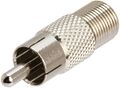 Male RCA to Female F-Type Video adapter

Radio Shack offered this as Catalog Number 278-252 [2]. During the CoCo's market life, this part was Archer-branded. Later, it was Radio Shack-branded.
The adapter connects on the CoCo side and a television cable is used for the run. Television coax cables (RG-58 or RG-6) are typically well-shielded unless damaged.
